With the implementation of the new national standard, lithium battery manufacturing faces more stringent requirements in terms of safety and consistency. As a core process in the front-end manufacturing of batteries, coating directly affects the consistency of electrode sheets, which in turn further influences battery safety and electrochemical performance.
Meanwhile, production lines are undergoing continuous upgrades toward wider formats, higher speeds, and greater continuity. The adjustment windows for key quality parameters—such as coating areal density, dimensions, and A/B-side registration—are narrowing, imposing far more demanding requirements on the precision and efficiency of process control.
In actual production, process parameters such as chamber pressure, screw pump speed, and web tension fluctuate frequently. The traditional "detect abnormality → execute adjustment → re-inspect" approach is time-consuming, and the adjustment lags behind the fluctuation, making it difficult to ensure stable coating quality over time.
Against this backdrop, the key to coating process control is shifting from "measure first, adjust later" to real-time closed-loop control of "measure while adjusting, adjust while measuring"—achieving a transition from passive response to proactive regulation.
I.Technical Architecture: Closed-Loop Control Chain for Areal Density and Coating Dimensions
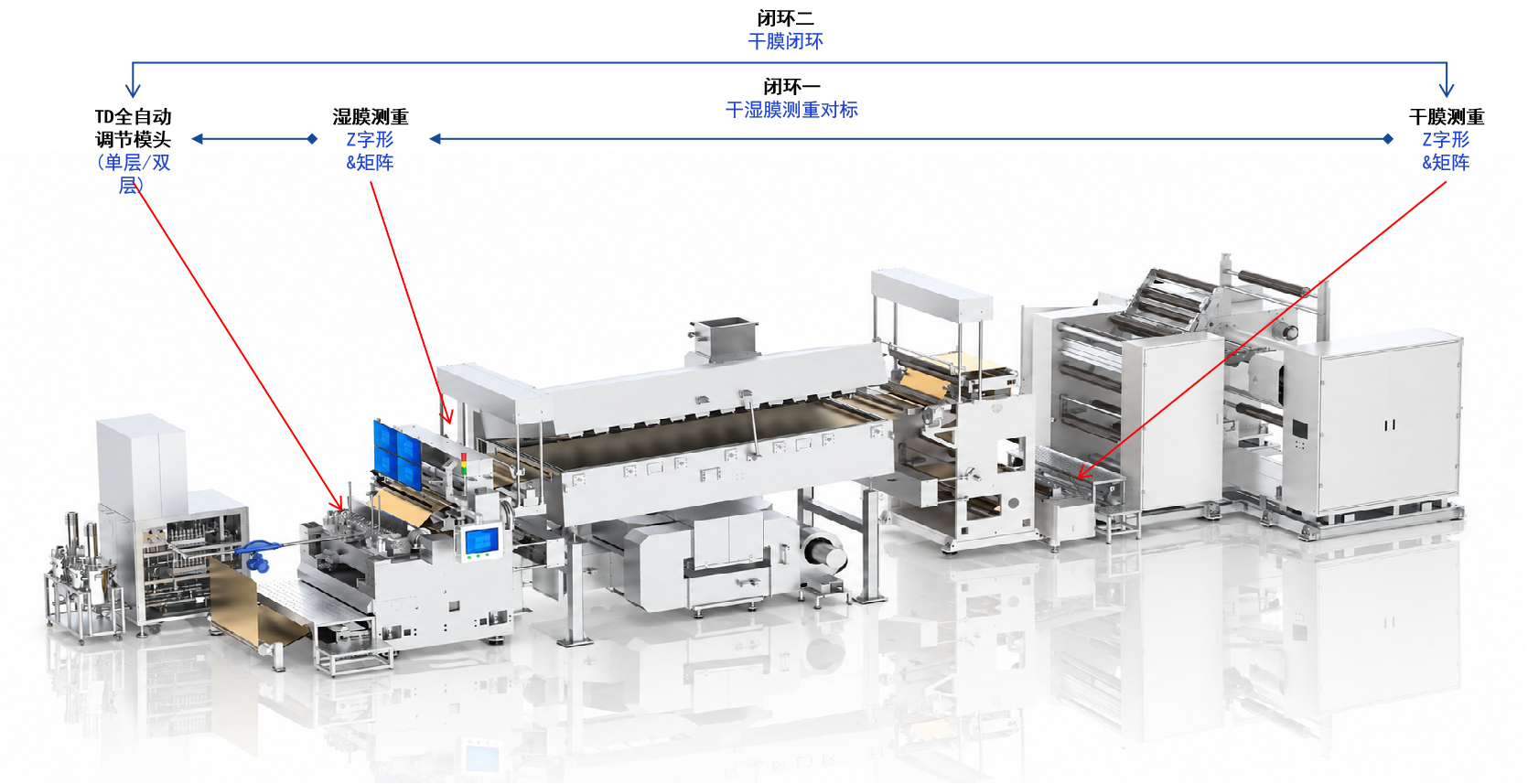
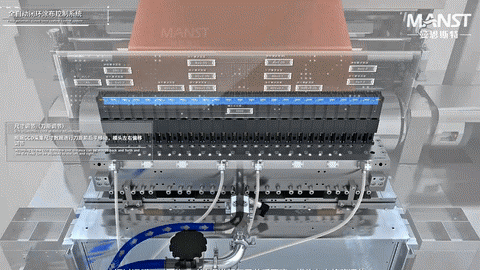
To address the pain points above, Manst (Manst Technology) has developed a fully automated closed-loop system solution that achieves closed-loop control of areal density and coating dimensions, with detection, decision-making, and execution fully automated. The system integrates a fully automatic slot-die coating head, electric actuators, a closed-loop control system, slurry delivery system, dry/wet film areal density gauges, dry/wet film CCD units, gap adjustment, die transverse-shifting, and deviation-correction servo units, forming a real-time information loop via industrial communication protocols. On the detection side, full-width coverage of areal density and CCD inspection is achieved, with 100% detection rate and 3σ repeatability of ±1‰, providing a reliable data foundation for closed-loop adjustment.
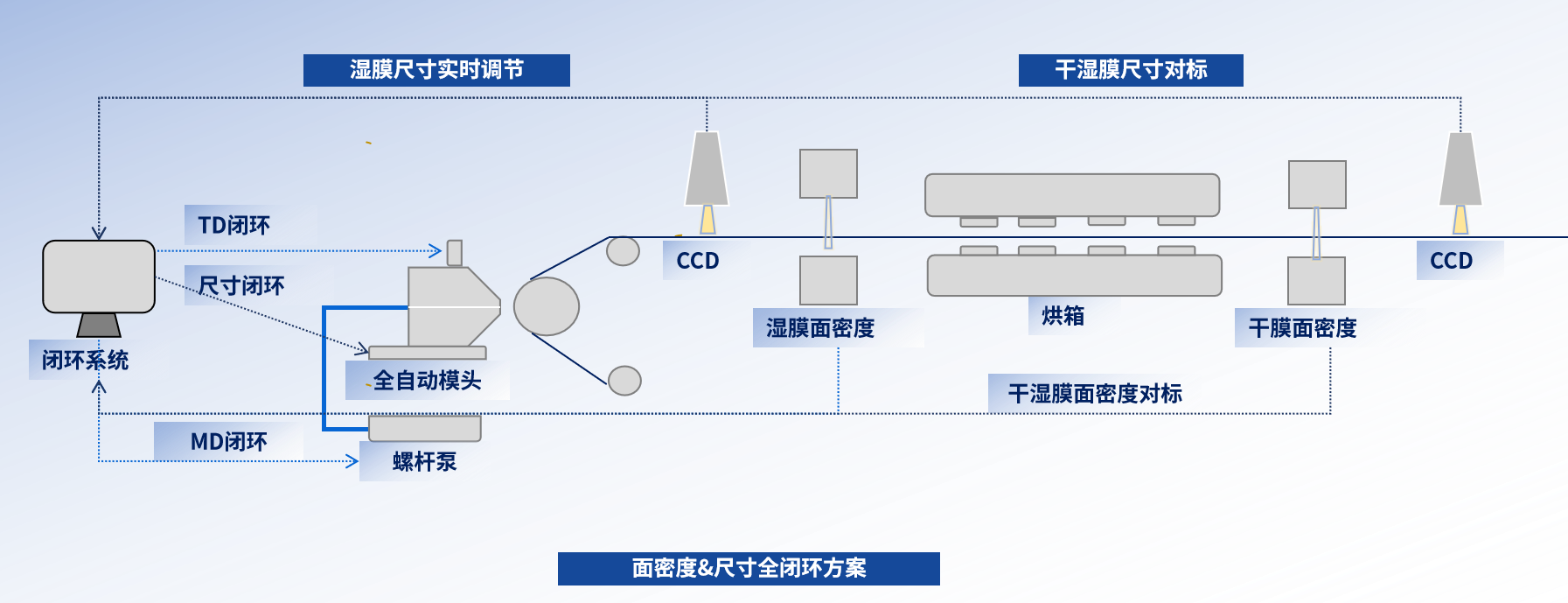
The areal density closed loop collects real-time dry- and wet-film areal density data through full-width areal density gauges and performs synchronized compensation, combining zonal T-bar adjustment of the die with screw-pump speed control to achieve closed-loop regulation in both the TD (transverse) and MD (machine) directions. The dimensional closed-loop control relies on CCD vision with synchronized compensation of dry/wet film data to rapidly adjust coating dimensions.
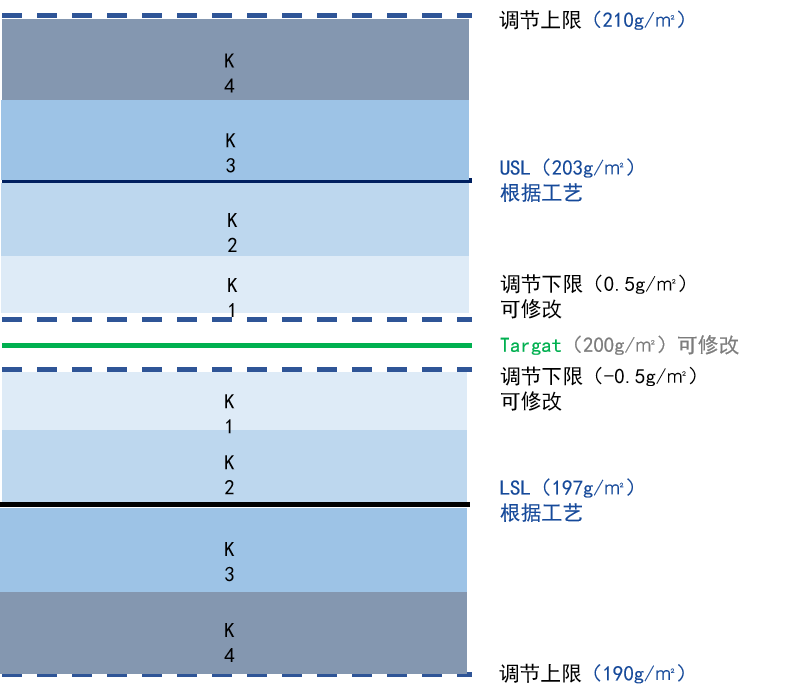
During adjustment, the system compares the collected data against baseline parameters such as target values and process recipes. After Kalman filtering for noise reduction and outlier rejection, a dynamic pre-adjustment model is constructed. Based on this adjustment model, a proprietary AI neural network algorithm generates a command chain that is dispatched to the actuators. Once the adjustment is complete, the system cyclically re-collects data for iteration and parameter optimization, forming a full closed-loop process of "data acquisition → algorithm analysis → precise adjustment → iterative optimization," thereby achieving high-precision, consistent coating results.
II. Two Major Closed Loops: Precision Control of Areal Density and Coating Dimensions
Centered on the two key metrics of areal density and coating dimensions, the system comprises four closed-loop modules, centrally scheduled and operated in coordination by the fully automatic closed-loop system. While ensuring the stability of individual metrics, it handles the coupling relationships between parameters, jointly improving overall coating consistency.
TD & MD Dual Closed-Loop Decoupled Control
The areal density closed-loop solution adopts a globally decoupled dual-loop control architecture for the TD (transverse) and MD (machine) directions, enabling precise regulation of transverse and longitudinal areal density and solving the industry pain points of insufficient adjustment precision and deviation coupling inherent in traditional single-loop control.
01 TD Areal Density Closed-Loop Adjustment
Transverse areal density takes the process-standard areal density of the electrode sheet as the core control target, employing coordinated calibration of dry and wet films: wet-film inspection collects data in real time before drying for early-stage deviation intervention and calibration of the dry-film value; dry-film inspection measures the areal density of the dried electrode sheet, serving as the final basis for precision correction. After comparing the measured values with the setpoints, the system generates adjustment amounts that drive the corresponding die-zone adjustment blocks to displace with an accuracy of ±1 μm, correcting local slurry flow and achieving uniform coating in the TD direction.
02 MD Areal Density Closed-Loop Adjustment
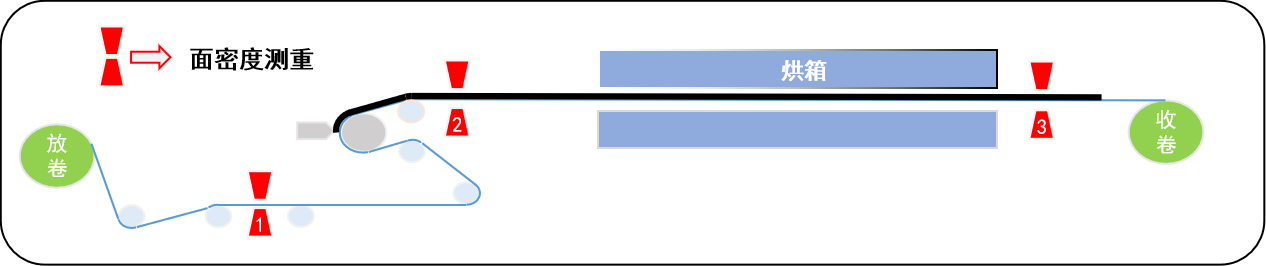
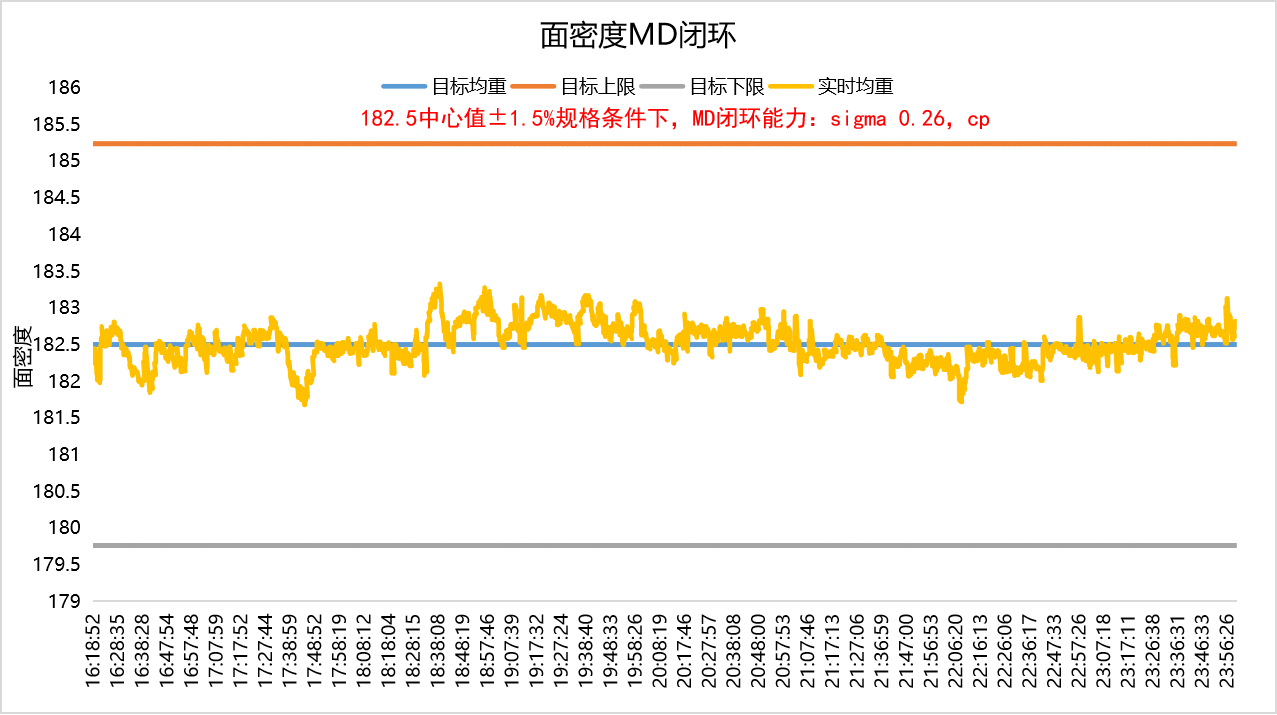
The MD areal density closed loop takes longitudinal uniformity of areal density as the core control target. The system compares longitudinal areal density data against process targets and dynamically adjusts the feed rotation speed via a high-precision servo screw pump, supported by coordinated wet- and dry-film calibration to ensure stable longitudinal areal density. Mass-production data show that the areal density COV can be controlled at approximately 0.2%, guaranteeing cell capacity consistency and reducing batch-to-batch variation between cells.
Global Decoupling Solution for Closed-Loop Dimensional Control
The dimensional closed-loop control adopts a globally decoupled architecture combining a coating-dimension loop with an A/B-side registration loop. The two modules operate independently yet in coordinated linkage, reducing the loss of effective coating area and the risk of packaging dimensions out of tolerance, and providing core process support for cell packaging dimensional precision and battery energy density.
03 Coating Dimension Closed-Loop Adjustment
The goal of coating dimension control is to ensure the dimensional accuracy of geometric features such as coating width, spacing, and the thinning zone. The system employs CCD vision for online measurement; after outlier rejection, least-squares mean filtering, and tolerance comparison, it generates gap adjustment commands, and precisely fine-tunes the die gap servo mechanism via the PLC.
04 A/B-Side Registration Closed-Loop Adjustment
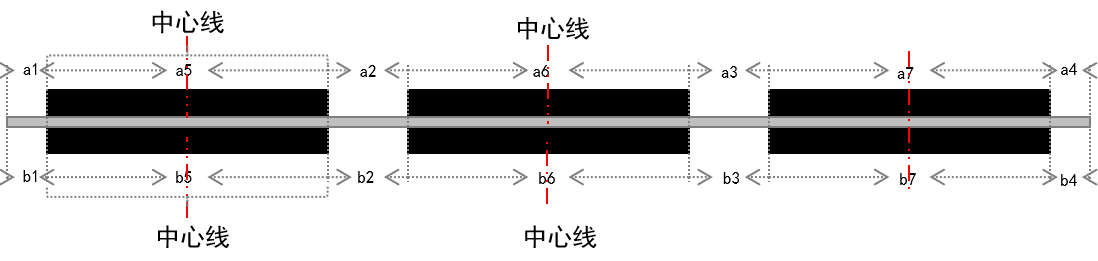
To address relative position deviations between the A and B sides of double-sided coatings, the system uses dual-side CCD vision to obtain the width centerlines and coating centerlines of the A and B sides, and calculates the A/B-side misalignment values of each coating edge. It then generates adjustment commands based on a proprietary multi-line misalignment trade-off algorithm, driving the die transverse-shifting servo mechanism and the web-guiding system to correct the position and achieve precise registration.
III. Field Validation: Cost Reduction and Efficiency Gains Supported by Mass-Production Data
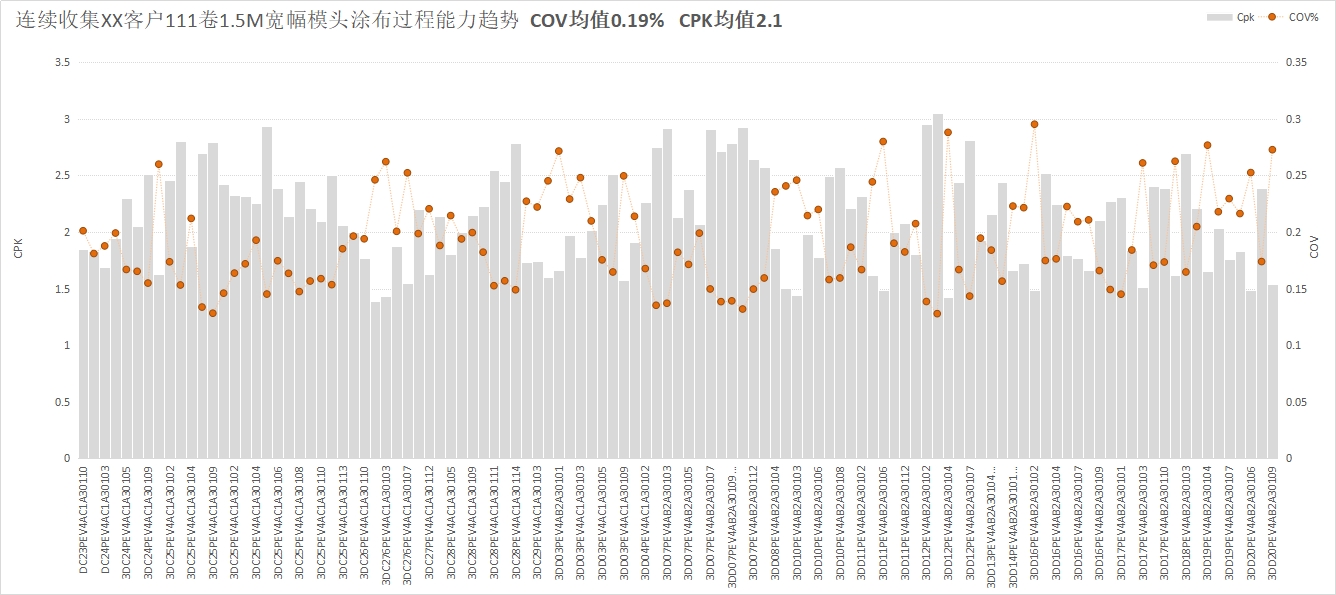
In validation on production lines of leading manufacturers, this solution has demonstrated strong application results, with electrode sheet consistency improved by ≥30%. On this basis, line OEE increased by 3%–5%, achieving coordinated optimization of quality consistency, equipment efficiency, product yield, and production resource allocation.
In terms of quality metrics, after closed-loop adjustment with a 15 mm zone width, the areal density process performance improved by ≥30%; with A/B-side registration accuracy of ±0.5 mm, the coating process capability index Cpk > 1.33, laying a process foundation for cell consistency.
In terms of ramp-up efficiency, the solution enables rapid areal-density stabilization: the number of first-piece commissioning attempts was reduced from an average of 3–5 to just one. Based on an average of four attempts, material loss was reduced by 75%, helping customers achieve rapid changeover and ramp-up while lowering mass-production material costs.
The system also features process learning capabilities, iteratively refining adjustment strategies based on measured data, and building a database covering product recipes, thinning zone, start-of-coating control optimization, and in-process abnormality adjustment strategies. The time to stabilize areal density after adjustment is ≤1 min, enabling one-click closed-loop operation and intelligent production.
IV. Conclusion
Built upon an intelligent process iteration system, Manst's fully automated closed-loop coating system solution consolidates inspection data, adjustment strategies, and process experience into reusable data assets that continuously feed back into process decision-making, driving coating control from manual experience toward data-driven control. Moving forward, Manst will continue to develop digital capabilities spanning data acquisition, process control, and process optimization—allowing production data to keep feeding back into process decisions and advancing coating from automated control toward data-driven intelligent manufacturing.
NO.3, Zhukeng Third Industrial Zone, Jinniu East Road, Pingshan District, Shenzhen
0755-89369630
400-822-5968
brand@sz-manst.com